

 Destinations
There is a particular kind of travel that sits at the intersection of sport, spectacle, and genuine cultural immersion, and 2026 has delivered more of it, in more destinations, than any year in recent memory.
The Winter Olympics came to Northern Italy in February, the most geographically expansive Winter Games ever staged, spanning a 410-kilometre corridor from Milan’s urban arenas to the high-altitude slopes of the Dolomites, across eight different towns and alpine areas in the Lombardy, Veneto, and Trentino-Alto Adige regions. Fashion Week and the Olympic Games colliding in Milan. Alpine skiing in Cortina d’Ampezzo. Speed events in Bormio. The Opening Ceremony at San Siro and the Closing Ceremony at the ancient Arena di Verona.
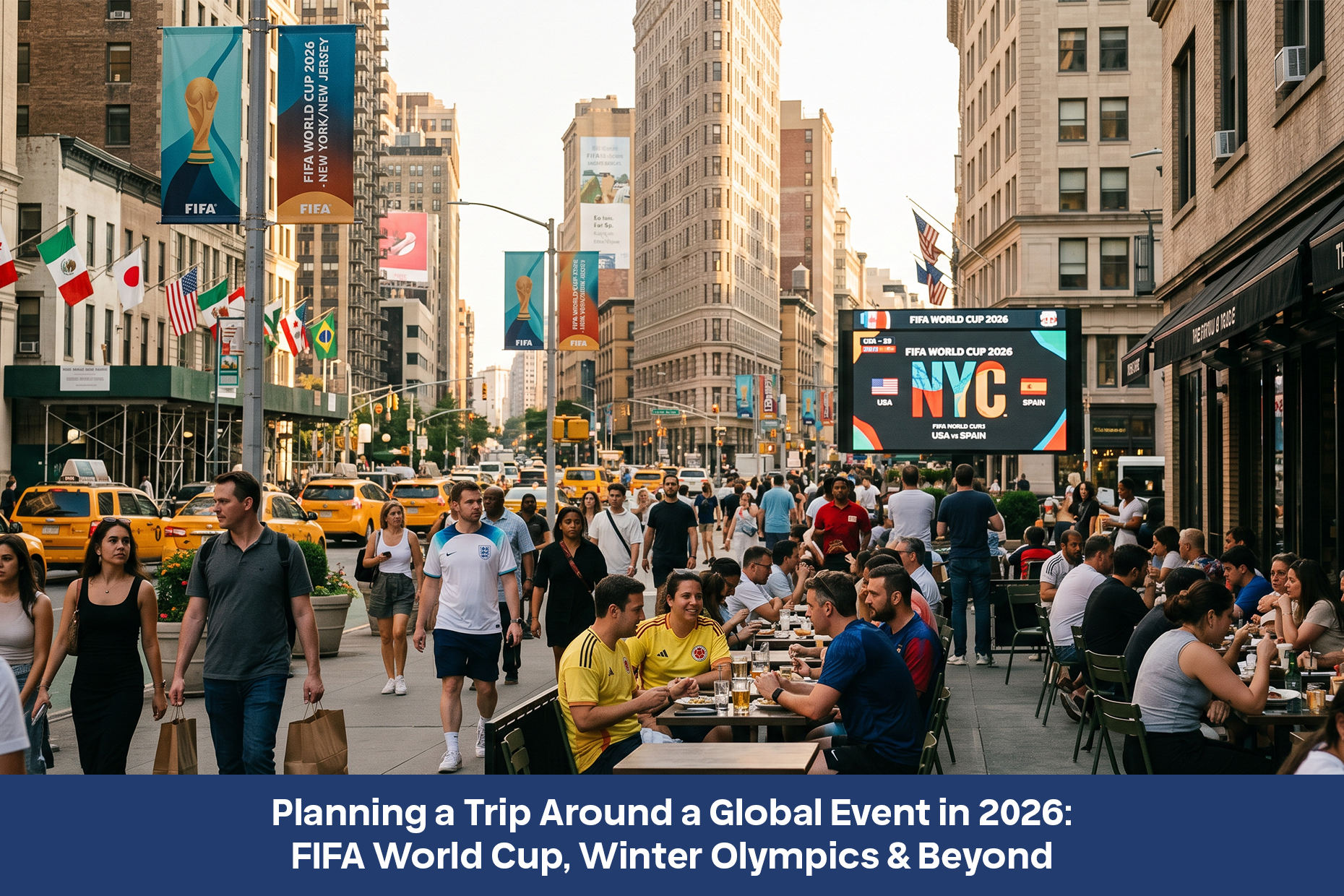
Then, beginning June 11, the FIFA World Cup arrives in North America, a historic tournament spanning three countries and featuring 48 national teams competing across 104 matches in 16 host cities, with the Final at New York/New Jersey stadium on July 19, 2026.
Two of the world’s three or four most watched sporting events, in the same calendar year, on two different continents. For luxury travellers who plan around experiences rather than destinations, 2026 is a once-in-a-generation moment.
But event-based luxury travel, done properly, is genuinely complex. It requires access, logistics, and an itinerary architecture that treats the event as a centrepiece rather than the only element. This guide covers both major 2026 events, what luxury travel around them actually looks like, and how Joan Qualls at Tasteful Voyages designs these journeys for clients who want the best of both the spectacle and the destination.
The FIFA World Cup 2026: The Largest in History Across Three Countries
The FIFA World Cup 2026 will take place across Canada, Mexico, and the United States from June 11 to July 19, 2026, returning to North America for the first time since 1994. FIFA has entrusted On Location to deliver its largest hospitality programme ever, providing fans with unprecedented access to the tournament.
The scale is genuinely unprecedented. The FIFA World Cup 2026 will be the most inclusive and diverse sporting event ever, with three host countries, 16 host cities, 48 teams, and 104 matches uniting the entire world across 16 stadiums and engaging billions more worldwide.
For luxury travellers, the first decision is which cities and which matches to anchor the itinerary around. The 16 host cities are spread across a vast geography, and the experience of attending a World Cup match in Los Angeles is genuinely different from attending one in Mexico City, which is genuinely different again from Vancouver or Miami. Understanding those differences is the starting point for building a coherent luxury World Cup itinerary.
The US Cities
Los Angeles is preparing for massive crowds, hosting the US Men’s National Team’s opening match on June 12 at SoFi Stadium. The city offers incredible luxury, from the exclusive enclaves of Beverly Hills to private yacht charters off the coast of Malibu. Miami will be another major hotspot, bringing its signature glamorous nightlife, pristine beaches, and high-end shopping to the World Cup stage. Other exceptional US host cities include Atlanta, Boston, Dallas, Houston, Kansas City, Philadelphia, San Francisco, and Seattle.
New York/New Jersey hosts the Final on July 19, the single most coveted ticket in the tournament. Venue Series packages at New York New Jersey Stadium include the FIFA World Cup 2026 Final, available through private suites and pitchside lounges as part of the official On Location hospitality programme.
Canada and Mexico
Toronto and Vancouver offer exceptional Canadian hospitality and gorgeous waterfronts. Mexico City, Guadalajara, and Monterrey promise a passionate, electric atmosphere deeply rooted in football history, complete with exquisite culinary scenes and rich cultural heritage.
Mexico City in particular deserves special attention in any luxury World Cup travel conversation. The city’s football culture is unlike anything in North America, the atmosphere at a match in Mexico City is a visceral, communal experience that has no equivalent on the US side of the border. For travellers who want to understand what this sport actually means to the people who grew up with it, Mexico City is where that understanding lives.
The Hospitality Structure
Hospitality package options include the US Venue Series, securing access to 4–9 matches at a single venue with premium seating in private suites and pitchside lounges, the US Four-Match Series across various US venues, and the Follow My Team Series, which allows fans to see their team in action at every early-stage match regardless of location. All packages include access to FIFA Pavilion, the exclusive retreat near the respective stadium for pre-and-post match hospitality and entertainment.
The luxury suite offerings represent the pinnacle of World Cup hospitality, private lounges, premium seating, gourmet catering, and personalised concierge services, with dedicated staff on hand to meet any request, whether arranging transport, securing tickets for other events, or organising unique local experiences in the host cities.
The Multi-City Logistics Challenge
This is where event-based luxury travel requires the most careful planning, and where working with Joan Qualls at Tasteful Voyages makes the most significant difference.
The logistics of moving across three massive countries cannot be underestimated. FIFA World Cup travel in 2026 requires careful attention to immigration, transit, and timing. Moving between the US, Canada, and Mexico may require multiple visas, Electronic Travel Authorizations, or ESTAs, depending on your citizenship. Traffic and airport congestion will be incredibly dense in the days surrounding major matches.
Between host cities, private jets ensure a smooth and effortless journey, bypassing the commercial transit chaos that will define the World Cup period in all 16 host cities. For intra-city travel, relying on rideshares during match days is a recipe for frustration.
A well-designed luxury World Cup itinerary treats the transit between cities as an asset rather than a liability, building in enough time in each city to actually experience it, positioning accommodation close enough to venues to make match days manageable, and layering in the culinary, cultural, and social experiences that make each host city worth visiting in its own right.
Joan Qualls works with Tasteful Voyages’ luxury travel partners to build these multi-city frameworks, handling the visa logistics, private transfer coordination, accommodation selection in each host city, and event access through authorised hospitality channels.
The Milano Cortina 2026 Winter Olympics: Italy’s Most Extraordinary Winter
The Winter Olympics concluded in February 2026, but understanding what they delivered is directly relevant to event-based luxury travel planning, both as a model for how Italy handles global events and as context for travellers already looking ahead to LA 2028 and beyond.
Milano Cortina 2026 was the most geographically widespread Winter Olympics ever staged, spanning eight different towns and alpine areas across Northern Italy, with the urban buzz of Milan, the Alpine charm of Cortina and the Dolomites, and historic cities like Verona all playing distinct roles in the Games.
What made it extraordinary from a luxury travel perspective was the combination of world-class sport in spectacular Italian landscapes, and the surrounding cultural and culinary richness that only Northern Italy can provide.
February 2026 was a historic month where the world of sport and the world of luxury prêt-à-porter collided, with the Olympic Games taking place right alongside the preparations for Milan Fashion Week, creating an atmosphere in the city unlike any previous Olympic host.
Key cultural stops in Milan for Games visitors included the Duomo di Milano with rooftop views, Leonardo da Vinci’s The Last Supper (requiring advance booking), La Scala Opera House, and Castello Sforzesco with Sempione Park. Between morning sessions at the alpine venues and evening galas in the fashion district, a single day in February 2026 Milan could encompass experiences from four or five different categories of extraordinary.
Events were spread across the full corridor of Northern Italy, skating in Milan’s Santa Giulia district, alpine skiing against the backdrop of Cortina, speed events in Bormio, freestyle skiing and snowboarding in Livigno, ski jumping in Predazzo, cross-country in Tesero, and the Closing Ceremony at the ancient Arena di Verona.
The model Milano Cortina established, combining a world-class sporting event with luxury accommodation in extraordinary Italian settings, cultural immersion in one of the world’s great fashion and design cities, and the Dolomites as a backdrop, is the template for what event-based luxury travel at its finest looks like.
For those looking ahead, On Location, the same hospitality provider handling FIFA World Cup 2026, is the official hospitality provider for the IOC across Paris 2024, Milano Cortina 2026, and LA 2028. The infrastructure for luxury Olympic hospitality is now consistent and professional across games cycles, making advance planning for future events a meaningful strategy for discerning travellers.
Beyond the Two Marquee Events: What Else 2026 Delivers
The FIFA World Cup and Winter Olympics are the headline events, but 2026’s global sports and cultural calendar extends considerably further for luxury travellers who plan around experiences.
The Ryder Cup in New York (September 2026) Golf’s most passionately contested team event returns to Bethpage Black in New York, one of the most dramatic public golf courses in the United States. The Ryder Cup atmosphere is unlike any other event in golf, and New York in September is as compelling a backdrop as any in American sport.
Formula 1 Grands Prix The 2026 F1 season introduces a new generation of cars and a revised calendar that continues to add destination-quality venues. Monaco, Monza, Silverstone, and the US Grand Prix in Austin remain on the calendar alongside newer additions. For luxury travellers, a Grand Prix weekend is a natural anchor for a broader destination itinerary, Monaco in May, Tuscany and Monza in September.
Cultural and Festival Travel For travellers whose event-based travel extends beyond sport, 2026 offers Venice Biennale (architecture edition), Edinburgh Festival, Cannes Film Festival, and a range of music festivals across Europe that reward early planning and the right accommodation positioning.
The Architecture of Event-Based Luxury Travel: How Joan Designs These Itineraries
The most common mistake in event-based travel is treating the event as the entire trip. Buy the tickets, book a hotel nearby, fly home. The event becomes a transaction rather than an experience, and the destination, which might be one of the world’s great cities, gets three hours of attention between the hotel and the stadium.
The way Joan Qualls at Tasteful Voyages designs event-based luxury travel is fundamentally different. The event is the anchor, the moment that makes the specific dates non-negotiable and gives the itinerary its emotional centrepiece. Everything around it is designed to make the host city live up to its potential as a travel destination in its own right.
For a FIFA World Cup itinerary built around the Final at MetLife Stadium in New York, that means building an itinerary that treats New York as the extraordinary city it is, with days before the match spent in the ways that only New York’s finest hospitality, cultural institutions, and restaurant scene can fill. It means arriving with enough time to actually be in the city rather than in transit anxiety. And it means having the private transfers, accommodation positioning, and concierge support that makes match day itself feel effortless rather than stressful.
Industry reports confirm that demand for luxury and all-inclusive travel experiences around major events is rising, with many fans opting for organised packages rather than independent travel due to logistical challenges and high demand for accommodation. The difference between an organised package and what Joan Qualls designs isn’t just quality, it’s personalisation. A package gives every client the same thing. Joan gives each client what their specific version of this trip should be.
Through Tasteful Voyages’ Virtuoso network connections, Joan accesses hotel relationships in every World Cup host city, private jet and transfer partnerships for inter-city movement, and the kind of local expertise that turns a generic match-day experience into something genuinely memorable. For clients interested in adding a cruise element, arriving in Miami by sea for a World Cup match, or combining a European river cruise with travel to a Formula 1 Grand Prix, Joan’s luxury cruise partnerships provide seamless integration between the event and the broader journey.
The best event-based luxury travel doesn’t look like sports tourism. It looks like a beautiful, well-designed trip that happens to have an extraordinary moment at its centre, a moment that gives the whole journey its meaning.
CTA
The FIFA World Cup 2026 Final is July 19 in New York. The best hotels in every host city, Los Angeles, Miami, Mexico City, Toronto, are filling now. The luxury hospitality packages through official channels are limited and sell on first-come-first-served basis.
If event-based luxury travel is on your 2026 agenda, for the World Cup, Formula 1, the Ryder Cup, or any other global event, Joan Qualls at Tasteful Voyages is the person to call.
📞 760-815-7400 ✉️ [email protected] 🌐 tastefulvoyages.com/contact-us
Frequently Asked Questions
When is the FIFA World Cup 2026 and which cities are hosting?
The FIFA World Cup 2026 runs from June 11 to July 19, 2026, across 16 host cities in the United States, Canada, and Mexico, with the Final at New York/New Jersey Stadium on July 19. Major hosts include Los Angeles, Miami, Dallas, Toronto, Vancouver, Mexico City, Guadalajara, and Monterrey.
How do I book luxury hospitality packages for the FIFA World Cup 2026?
Official FIFA World Cup 2026 hospitality packages — private suites, pitchside lounges, Venue Series, and Follow My Team Series — are sold exclusively by On Location via FIFA.com/hospitality and authorised sales agents. Joan Qualls at Tasteful Voyages coordinates access through authorised channels as part of a fully designed luxury itinerary.
What made the Milano Cortina 2026 Winter Olympics a luxury travel experience?
Milano Cortina 2026 was the most geographically expansive Winter Olympics ever staged, spanning a 410-kilometre corridor from Milan’s urban arenas to the Dolomites across eight towns. The Games coincided with Milan Fashion Week preparations, pairing world-class alpine sport with Italy’s fashion, culinary, and cultural capital.
What is event-based luxury travel?
Event-based luxury travel is a fully personalised itinerary anchored by a global event — a World Cup Final, an Olympic ceremony, or a Formula 1 Grand Prix — rather than built entirely around it. Unlike fixed packages, a Virtuoso advisor like Joan Qualls designs accommodation, transfers, and experiences around each client’s travel style.
Which FIFA World Cup 2026 host city is best for luxury travel?
New York offers the Final plus world-class hotels and dining; Los Angeles combines coastal luxury with entertainment; Miami delivers beaches and nightlife; Mexico City has the tournament’s most passionate football atmosphere and an exceptional culinary scene. The right choice depends on your team, your matches, and your travel style.
How far in advance should I book luxury travel for the FIFA World Cup 2026?
Book immediately. Luxury hotel inventory in New York, Los Angeles, and Miami is already heavily committed for the Final and marquee matches, and On Location hospitality packages sell first-come, first-served. Early booking secures top-tier properties, official hospitality access, and private inter-city transfers between host cities.

