

 Destinations
Most first-time Morocco travellers return home having seen the same things. The Jemaa el-Fna at dusk. The Chouara tanneries from a leather shop balcony. The blue streets of Chefchaouen. The camel ride at Erg Chebbi as the sun drops behind the dunes.
All of it is real. All of it is extraordinary. And all of it has been photographed millions of times by people who stood in the same spots last week.
Morocco is one of those rare countries that rewards repeat visits, not because the first trip wasn’t enough, but because what most travellers see on a first trip barely scratches the surface of what the country actually contains. The second Morocco, the one that lies beyond the well-worn medina trails and the standard imperial cities circuit, is arguably more spectacular than the first.
In the realm of high-end travel, Morocco has transcended its reputation as merely an exotic destination. Today’s discerning travellers are moving beyond traditional sightseeing into what industry insiders call deep-tier experiential immersion, where every moment is curated, every transition seamless, and every experience unforgettable. Morocco’s infrastructure upgrades for the Africa Cup of Nations have ushered in modernised airports, enhanced connectivity, and world-class hospitality standards, while simultaneously preserving the authentic cultural tapestry that makes this North African gem so compelling.
This blog is a guide to that second Morocco, the one accessible to travellers who work with a private Morocco tour advisor rather than booking a standard itinerary. It’s specific, it’s detailed, and it’s the basis on which Joan Qualls at Tasteful Voyages designs luxury Morocco travel itineraries for clients who want more than a beautiful riad and a guide to the souks.
Why Morocco Off the Beaten Path Is a Different Country Entirely
The standard Morocco itinerary, Marrakech, Fes, Sahara, home, is popular for a reason. These are genuinely great destinations with genuinely great things to see. But they’re also among the most visited places in North Africa, and during peak season the experience of navigating them independently or through a standard tour can feel more exhausting than immersive.
Morocco offers far more than Marrakech’s vibrant souks or Casablanca’s grand mosque. Exploring lesser-known areas reveals hidden gems, a fascinating glimpse of deep-rooted Berber culture, and opportunities for true cultural immersion. Travelling through Morocco’s less-visited places means discovering dramatic landscapes, unique villages, and a side of the country that often escapes large tourist crowds.
The luxury Morocco travel itinerary that Joan Qualls builds for Tasteful Voyages clients isn’t a rejection of the famous destinations, it’s a recalibration of how they’re experienced, combined with a genuine extension into places that most visitors simply never reach.
A dawn visit to the Chouara tanneries in Fes before the tour groups arrive. A private afternoon in Marrakech by vintage sidecar, slipping through medina backstreets the standard tours don’t enter. Three nights in a remote desert camp at Erg Chigaga rather than the more accessible Erg Chebbi. A detour through Moulay Idriss Zerhoun that no standard itinerary includes but that might be the most spiritually significant moment of the entire trip.
This is the craft of a good private Morocco tour advisor, not simply booking better hotels, but fundamentally rethinking what the itinerary contains and in what order it unfolds.
The Destinations Most Luxury Morocco Itineraries Miss
Moulay Idriss Zerhoun, Morocco’s Sacred Heart
Moulay Idriss Zerhoun is one of the most sacred cities of Morocco, located on two green hills not far from Meknes and named after the founder of the country, Moulay Idriss I. Not long ago, any non-Muslim was not permitted to spend the night here, and this has helped preserve its extraordinary authenticity. Those who find their way here are treated to breathtaking panoramic scenes, maze-like streets, and the hospitality of a very traditional society.
Most itineraries visit Meknes as an afterthought to Fes, a day trip to see the imperial granaries and the Mausoleum of Moulay Ismail. Moulay Idriss Zerhoun, just a short drive away, is almost always omitted. It shouldn’t be. Combined with Volubilis, the most extensive and best-preserved Roman ruins in North Africa, sitting improbably in the Moroccan countryside surrounded by olive groves, this region offers a day of extraordinary depth that most Morocco visitors never experience.
The Roman ruins of Volubilis stand remarkably preserved amidst olive groves, one of the best-preserved Roman ruins in North Africa, yet often overlooked, with stunningly intact mosaics and arches and far fewer tourists than European counterparts.
Asilah, The Atlantic Art Town
The town of Asilah on the Atlantic Coast charms visitors with colourful murals and a local art scene, offering a much slower pace than busier cities. Originally a Phoenician settlement, Asilah was later colonised by the Portuguese and Moroccan peoples, an interesting cultural mix with peaceful Atlantic beaches unlike the larger coastal cities.
Asilah is the kind of town that makes you reconsider the whole trip itinerary. Whitewashed walls covered in murals commissioned from international artists. A rampart walk above the Atlantic. A café where you can spend an entire afternoon and feel no pressure to move. It’s everything that Marrakech isn’t, and that contrast is exactly what makes it worth including.
Erg Chigaga, The Real Sahara
Choosing your dunes matters significantly. Erg Chebbi near Merzouga offers grand, accessible desert landscapes popular with luxury travellers, while Erg Chigaga provides genuine wilderness remoteness for those seeking an authentic experience.
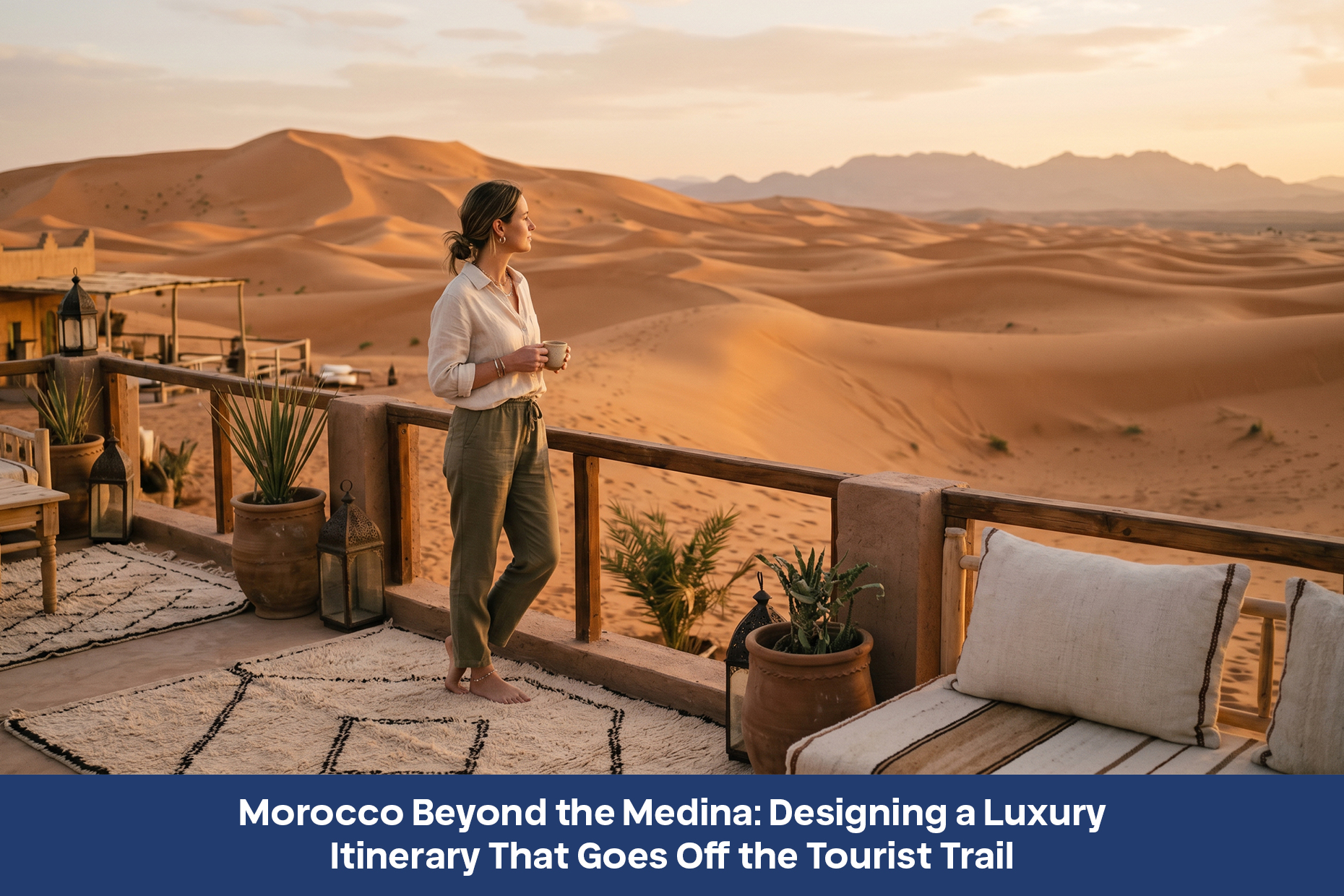
Erg Chebbi is magnificent, and it has become exactly as busy as its magnificence deserves. Erg Chigaga, accessible only by a long 4×4 drive across open desert or a chartered flight, has virtually no day-trippers and a handful of exclusive camps that are among the most extraordinary places to sleep in North Africa. The Sahara’s atmosphere is serene, almost dreamlike, a perfect contrast to the lively medinas of Morocco’s imperial cities. At Erg Chigaga, that serene quality is preserved completely. No generators audible from neighbouring camps. No convoy of quad bikes at sunset. Just the dunes, the silence, and a sky full of stars that has no competition from any artificial light source for a hundred kilometres in every direction.
The Ameln Valley and Anti-Atlas, Genuinely Off-Grid
The pretty Ameln Valley lies well off the beaten tourist trail and is undoubtedly one of Morocco’s hidden gems, located in the Anti-Atlas Mountains just north of Tafraoute. It’s the sort of place where you’ll probably not see another tourist all day. Hiking trails pass through remote villages and palm oases, and the famous Lion’s Face Rock keeps watch over the valley above the village of Asgaour. In the tiny village of Oumesnat, a 400-year-old Berber house doubles as a museum.
The nearby Painted Rocks and the Berber villages of Oumesnat and Anergui provide beautiful scenery and a chance to meet locals. The area remains largely untouched by commercial tourism.
This is Morocco off the beaten path in its most complete expression, a landscape and a culture that exists entirely outside the tourist circuit, accessible only to travellers willing to drive the distance and spend time with people who are genuinely surprised and delighted to see them.
Tamuda Bay, Morocco’s Mediterranean Riviera
The Mediterranean elegance of Tamuda Bay represents a different facet of Morocco, a coastal destination with a genuinely European sensibility that makes it ideal as the opening or closing sequence of a luxury Morocco travel itinerary built around contrast.
Near Tetouan on the northern Mediterranean coast, Tamuda Bay has developed a small collection of genuinely high-quality luxury properties, particularly the Indigo Tamuda Bay Hotel and the Mövenpick, with beach access, Mediterranean cuisine, and a pace of life that bears almost no resemblance to the medinas of the south. For travellers who want to begin or end the Morocco journey in restful coastal luxury before entering the intensity of the imperial cities, Tamuda Bay is the right opening chapter.
How to Experience the Famous Destinations Differently
The argument for Morocco off the beaten path isn’t that the famous places aren’t worth visiting, it’s that the standard way of visiting them delivers about 40% of what they actually offer. Here’s how a private Morocco tour advisor changes that calculus.
Marrakech by vintage sidecar. One of the most original ways to discover Marrakech is by vintage sidecar, gliding through the narrow streets of the medina, passing ancient riads, vibrant souks, and hidden architectural gems. With a local guide leading the way, this unusual journey reveals secret courtyards, artisan workshops, and historic monuments rarely visited by tourists. It is both cinematic and authentic, a stylish way to connect with the city’s living history.
The Yves Saint Laurent Museum after hours. Scheduling a private, after-hours viewing of the Yves Saint Laurent Museum allows you to appreciate the designer’s Moroccan-inspired collections without crowds, one of the most discreet and genuinely moving experiences Marrakech offers, and one that requires both connections and advance planning to arrange.
Dawn at the Chouara Tanneries. Every visitor to Fes sees the tanneries from a leather shop balcony during the middle of the day. The same view at 6 AM, before the tour groups, before the smell of the midday heat, when the workers are starting their day and the light is cool and golden, is a fundamentally different experience. This is the kind of access that a knowledgeable local guide, booked through a Virtuoso-connected private Morocco tour advisor, can arrange.
Fes beyond the Blue Gate. Visiting the less-crowded southern medina allows you to see the daily rhythm of Fes away from the better-trodden Blue Gate area. Local guides can further enrich your understanding of Fes’ architectural and spiritual heritage in ways that standard tour routes don’t allow. Seeking out quieter corners like the serene Dar Seffarine or the panoramic Borj Nord, a 16th-century fortress turned arms museum with sweeping city views, reveals a Fes that most visitors walk past without realising it’s there.
A Berber tea ceremony in the Atlas Mountains. As luxury 4×4 vehicles depart toward the spectacular Atlas Mountains, as the landscape shifts from palm groves to dramatic peaks, a private experience awaits in traditional Berber villages: a tea ceremony with a Berber family overlooking the mountains. This is the kind of moment that can be arranged genuinely or performed for tourists, and the difference between the two is entirely about the quality and depth of the local relationships that your advisor has built over time.
Where to Stay: Accommodation That Belongs in the Itinerary
The right accommodation in Morocco doesn’t just support the itinerary, it is the itinerary. A night in a genuinely great riad in the Fes medina is an experience in itself. The question is which riad, and which suite.
Riad Fes, a palace-style riad located inside the ancient medina, blends Andalusian architecture with refined Moroccan design, the Royal Suite offers generous spaces, intricate zellige tilework, carved cedar ceilings, and elegant salons that evoke an aristocratic residence.
In Marrakech, Riad Yasmine combines traditional zellige tilework with modern amenities, while L’Hotel Marrakech delivers contemporary minimalism in the heart of the medina. For post-dinner shopping, women’s cooperatives like Dar Mejbar offer fixed prices supporting artisan communities directly, and high-end Moroccan brands including Marrakshi Life and Maison ARTC offer private shopping experiences in elegant showrooms.
In Chefchaouen, Lina Ryad and the architecturally striking Dar Ba Sidi offer glass-walled suites framing mountain panoramas, a sophisticated accommodation option that adds a serene mountain dimension to the luxury Morocco travel itinerary.
Joan Qualls at Tasteful Voyages selects properties not from a catalogue but from firsthand knowledge and the recommendations of a Virtuoso network that covers Morocco’s finest riads and boutique properties. The properties Joan recommends are ones where she can advocate for specific room allocations, personalised arrival experiences, and the kind of service coordination that turns a good hotel stay into something genuinely memorable.
A Framework for a 12-Night Luxury Morocco Travel Itinerary
This is the structure Joan Qualls builds for clients who want the full Morocco range, famous and hidden, intense and peaceful, ancient and sensory.
Nights 1–2: Tamuda Bay. Arrive rested. Mediterranean coast, unhurried pace, beautiful setting before the medina energy begins.
Nights 3–4: Chefchaouen and the Rif Mountains. The blue city, genuinely beautiful, and genuinely quieter than the imperial cities, with hiking into the surrounding mountains for travellers who want to move.
Night 5: Asilah. The Atlantic art town. One night is enough to understand why it’s different from everything else in Morocco.
Nights 6–7: Fes. Deep medina time. Dawn tanneries. Southern medina. Volubilis and Moulay Idriss Zerhoun as a full-day excursion.
Night 8: Skoura or the Draa Valley. The transition south. Skoura is a lush oasis in the heart of the Atlas Mountains, characterised by date palm groves and traditional kasbahs, a perfect destination to unwind in a serene natural setting before the desert. Rising Bank
Nights 9–11: Erg Chigaga. Three nights in the real Sahara. Silence, stars, dunes at dawn, and the kind of reset that only genuine wilderness provides.
Night 12: Marrakech. A final night for the vintage sidecar, the after-hours museum, the rooftop dinner. The city earns its place as the closing chapter when the rest of the itinerary has been this rich.
How Joan Designs This Journey at Tasteful Voyages
The difference between a luxury Morocco travel itinerary and a good one is almost entirely in the details, and the details are almost entirely in the relationships.
Joan Qualls at Tasteful Voyages builds Morocco itineraries with the same philosophy she brings to every complex journey: the itinerary should reflect the traveller’s specific interests and pace, not a standard template. A couple celebrating an anniversary moves differently than a family with teenagers. A Morocco first-timer needs different anchoring than a traveller returning for a second deep dive.
Through the Virtuoso network, Joan accesses the private guides, riad properties, and desert camp operators that she knows from direct experience and partner recommendations, not from a generic supplier list. She also plans Morocco as part of broader journeys, including travellers who combine Morocco with a Mediterranean luxury cruise aboard Windstar or Seabourn, sailing the Moroccan coast as part of a wider Iberian or Mediterranean itinerary.
For the traveller who has looked at a standard Morocco tour and thought “there has to be more than this”, there is. And the way to access it is through a private Morocco tour advisor who knows the country beyond the postcards.
CTA
Morocco is one of the world’s great travel destinations, and one of the most consistently underexplored, even by people who think they’ve done it. Joan Qualls at Tasteful Voyages designs luxury Morocco travel itineraries that go where the standard tours don’t.
Let’s talk about what your Morocco journey looks like.
📞 760-815-7400 ✉️ [email protected] 🌐 tastefulvoyages.com/contact-us
Frequently Asked Questions
What should a luxury Morocco travel itinerary include beyond the standard cities?
A. A genuinely complete luxury Morocco travel itinerary goes beyond Marrakech and Fes to include destinations like Moulay Idriss Zerhoun and Volubilis, the Atlantic art town of Asilah, the remote desert of Erg Chigaga rather than the more crowded Erg Chebbi, the Ameln Valley in the Anti-Atlas where you’ll probably not see another tourist all day, and Tamuda Bay on the Mediterranean coast. Joan Qualls at Tasteful Voyages designs private Morocco tour itineraries that combine the iconic and the genuinely off-trail into a single coherent journey.What makes Morocco off the beaten path better than the standard tourist circuit?
A. Travelling through Morocco’s less-visited places means discovering dramatic landscapes, unique villages, and a side of the country that often escapes large tourist crowds. The experiential difference is significant, instead of sharing a dawn moment at Volubilis with forty other visitors, you’re standing among the mosaics alone. Instead of a staged camel ride at a busy Sahara camp, you’re three nights at Erg Chigaga where the silence is genuine and the horizon belongs entirely to you.How does a private Morocco tour advisor change the experience?
A. A private Morocco tour advisor changes almost everything about how the itinerary functions, from which properties you stay in and which specific suites are allocated, to which local guides have genuine relationships in the communities you visit, to whether the dawn tannery visit actually happens before the crowds or alongside them. Joan Qualls at Tasteful Voyages works with Morocco as a specialist destination, using Virtuoso relationships and firsthand knowledge to build itineraries that no algorithm and no standard tour operator can replicate.What is the best time of year for a luxury Morocco travel itinerary?
A. Spring (March to May) and autumn (September to November) are the optimal windows, these periods offer comfortable temperatures across all Morocco’s diverse landscapes, from the Atlas Mountains to the Sahara and the Atlantic coast. Summer in the Sahara is extremely hot and should generally be avoided for desert components. The imperial cities and Atlantic coast are more manageable year-round, but peak summer (July–August) brings significant crowds to the most popular sites.Can I combine a Morocco itinerary with a Mediterranean luxury cruise?
A. Yes, and it’s one of the most elegant combinations available in this region. Lines like Windstar and Seabourn include Moroccan ports, typically Casablanca, Tangier, or Agadir, on Mediterranean and Iberian sailing itineraries. Joan at Tasteful Voyages regularly plans journeys that combine a private Morocco land programme with a luxury Mediterranean cruise, using the sailing to transition between Morocco and Spain, Portugal, or Italy. Contact Joan to discuss the combination →What is the Erg Chigaga desert experience and how is it different from Erg Chebbi?
A. Erg Chebbi near Merzouga offers grand, accessible desert landscapes popular with luxury travellers, while Erg Chigaga provides genuine wilderness remoteness for those seeking an authentic experience. Erg Chigaga is accessible only by a long 4×4 drive across open desert or a chartered flight, which means it has virtually no day-trippers, a handful of exclusive camps with genuine isolation, and a quality of silence and darkness that the more accessible Erg Chebbi simply can’t match during high season. For travellers whose luxury Morocco travel itinerary centres on the Sahara experience, Erg Chigaga is the right destination.

