

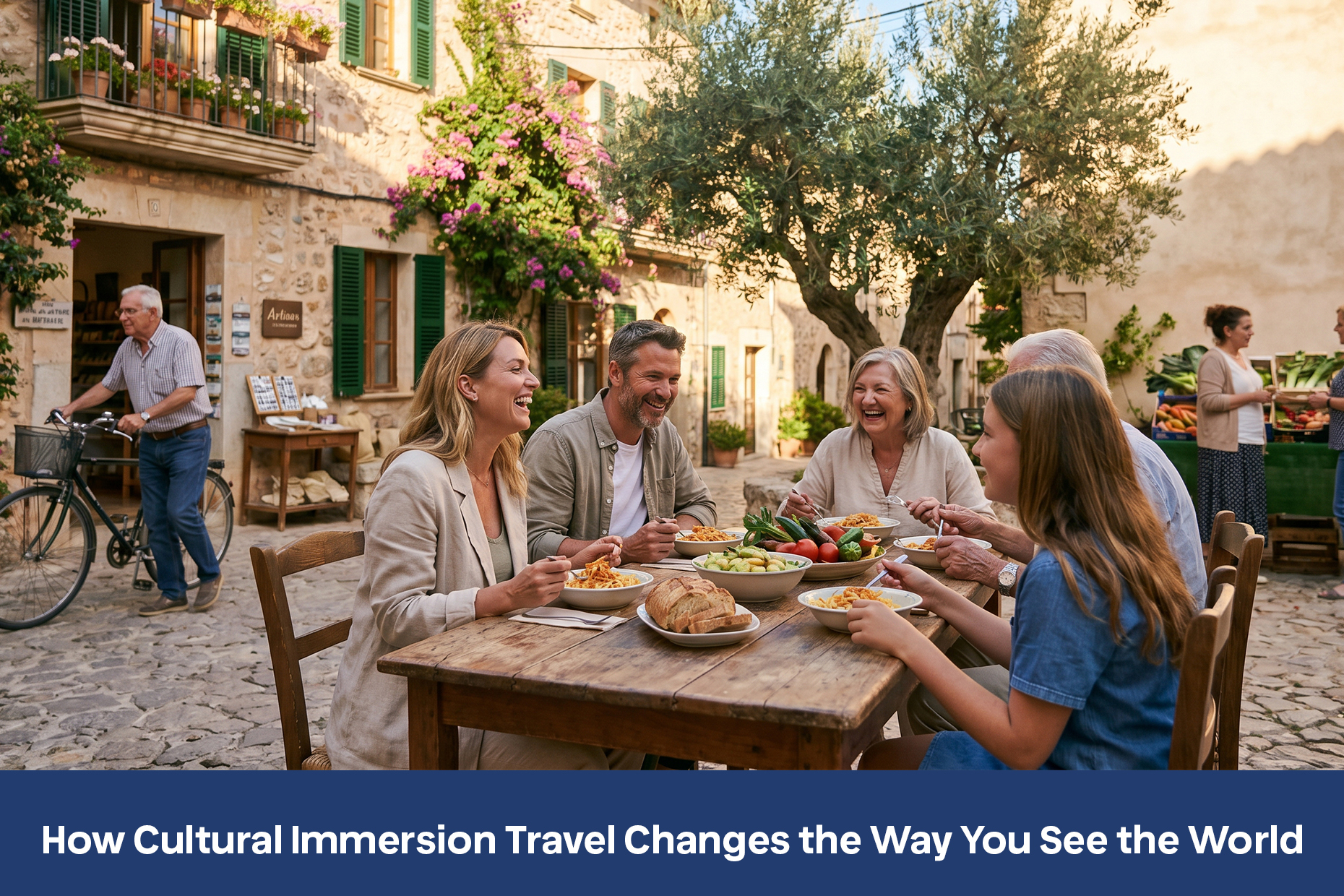
 Cultural Immersion Travel
Three years ago, a couple came to us wanting “the usual European vacation”, Paris, Rome, Barcelona, hitting the major sights. We suggested something different: spend those same two weeks living in one place. Rent an apartment in Lyon’s old quarter. Shop at the morning markets. Take a cooking class with a local chef. Befriend the baker who makes your morning croissant.
They were hesitant. “But won’t we miss seeing everything?”
When they returned, they told us: “We didn’t see everything. We saw something better, we understood a place. We made friends. We learned to make cassoulet from someone’s grandmother. That baker invited us to her daughter’s wedding. We’re already planning to go back next year to visit them.”
That’s the difference between cultural immersion travel and tourism. Tourism lets you see a place. Cultural immersion helps you understand it, and in the process, it changes how you see the entire world.
This isn’t just romantic travel philosophy. There’s substantial research showing that meaningful cultural engagement, eating local foods, learning languages, forming relationships with local people, understanding different worldviews, fundamentally alters how you think, increases empathy, reduces prejudice, and makes you more adaptable and creative.
This guide explores what cultural immersion travel actually means, why it transforms your worldview in ways conventional tourism doesn’t, how to practice it effectively, and where to start your own journey toward more meaningful, perspective-shifting travel.
What Is Cultural Immersion Travel? (Beyond the Buzzwords)
Let’s be clear about what we mean, because “cultural immersion” has become a travel industry buzzword that often gets attached to experiences that are anything but immersive.
Cultural immersion travel is:
Prioritizing depth over breadth: Spending meaningful time in fewer places rather than checking boxes across many destinations. You’re measuring success by understanding, not by attractions visited.
Engaging authentically with local people: Having actual conversations and forming relationships with residents, not just transacting with service workers. Learning people’s names. Hearing their stories. Sharing yours.
Participating in daily life: Shopping at local markets instead of supermarkets designed for tourists. Using public transportation. Attending community events. Doing laundry at the neighborhood laundromat and striking up conversations.
Learning local customs, traditions, and language: Making genuine effort to communicate in the local language (even badly). Understanding cultural norms around greetings, dining, personal space, and social interaction.
Eating authentically: Seeking out where locals eat, not where tourists eat. Learning about regional ingredients and cooking traditions. Taking cooking classes from home cooks, not celebrity chefs performing for cameras.
Challenging your assumptions: Staying curious when confronted with different ways of doing things. Asking “why do they do it this way?” instead of judging it against how you do things at home.
Cultural immersion travel is NOT:
- A “cultural experience” staged for tourists (traditional dance performance at your resort, “tribal village” tour)
- Staying in luxury hotels insulated from local life
- Hiring guides who tell you what to think rather than facilitating understanding
- Treating local culture as entertainment or spectacle
- Extracting Instagram content without genuine engagement
- Seven countries in ten days with superficial interactions everywhere
According to research published in the Journal of Personality and Social Psychology, individuals who engage in deeper cultural immersion (living abroad, forming local friendships, learning languages) show significantly greater increases in creativity, empathy, and cognitive flexibility than those who travel extensively but superficially.
Learn more about meaningful travel: Bespoke Travel Planning
Why Cultural Immersion Changes Your Worldview (The Science)
Here’s what actually happens in your brain and psychology when you engage deeply with different cultures:
1. It Challenges Your “Default” Assumptions About “Normal”
Every culture has unspoken rules about what’s “normal” or “correct”, how to greet people, appropriate personal space, meal timing and etiquette, family structures, work-life balance, concepts of punctuality, expressions of emotion.
When you grow up in one culture, these norms become invisible. They feel like universal truths rather than cultural constructions.
Cultural immersion makes the invisible visible. You realize that:
- Your concept of “polite” isn’t universal (Direct communication considered respectful in Germany, rude in Japan)
- Your relationship to time isn’t natural law (Northern European punctuality vs. more fluid concepts of time in many other cultures)
- Your family structure isn’t the only way (Multigenerational households common in most of the world)
- Your work schedule isn’t inevitable (The Spanish siesta, French lunch culture, Scandinavian work-life balance)
Why this matters: Once you recognize that your “normal” is just one way among many valid ways, you become more flexible, less judgmental, and better at adapting to new situations. Research from Michigan State University shows that people with deep multicultural experience are better problem-solvers because they can think outside their cultural frameworks.
2. It Builds Genuine Empathy (Not Just Sympathy)
Sympathy is feeling bad for someone. Empathy is understanding their perspective from the inside.
Cultural immersion builds empathy because:
You hear people’s actual stories, not stereotypes from media. The “lazy” culture you’d heard about? You learn about structural unemployment, colonial economic legacy, and how hard people actually work just to survive.
You experience vulnerability yourself. Trying to navigate a bus system where you can’t read signs or ask directions reminds you what it’s like to be an outsider, something immigrants to your country experience constantly.
You form relationships that personalize abstract “others.” The refugee crisis isn’t just news headlines when your AirBnB host in Berlin is a Syrian refugee rebuilding his life, sharing his family’s story over tea.
You see wealth and poverty in context. You understand that “poor” doesn’t mean unhappy, that different cultures define success differently, that community wealth isn’t the same as individual wealth.
Research from Intercultural Development Inventory shows that sustained cultural immersion is one of the most effective ways to move people from ethnocentric (my culture is best) to ethnorelative (all cultures have validity) worldviews.
3. It Makes You More Adaptable and Comfortable with Ambiguity
When you’re culturally immersed, you constantly encounter situations where:
- You don’t understand what’s happening
- The “rules” aren’t clear
- Your usual strategies don’t work
- You have to trust people you just met
- Plans change without explanation
- Communication is imperfect but you manage anyway
At first, this is uncomfortable. But over time, you build tolerance for ambiguity, the ability to function effectively even when you don’t have all the information, when situations are unclear, when outcomes are uncertain.
This skill transfers to everything: career challenges, relationship complexity, parenting, creativity, entrepreneurship. According to Harvard Business Review research, executives with significant international experience and cultural immersion demonstrate higher tolerance for ambiguity, a key predictor of success in complex, fast-changing environments.
4. It Expands Your Concept of What’s Possible
Every culture has found different solutions to universal human challenges:
- How to educate children (Finland’s approach, Montessori, apprenticeship models)
- How to handle elderly care (multigenerational homes, community care, different models)
- How to structure work life (German short work weeks, Japanese lifetime employment, remote work culture)
- How to define success and fulfillment (Material wealth, family bonds, community contribution, spiritual development)
When you see different models working well, you realize that “the way we do it at home” isn’t the only way, or necessarily the best way.
This expands your sense of possibility for your own life. Clients return from immersive travel and:
- Make career changes they’d never considered
- Restructure their family time and priorities
- Simplify their lives after seeing contentment with less
- Build more community in their home neighborhoods
- Rethink retirement and aging
5. It Reduces Prejudice More Effectively Than Any Other Intervention
According to a meta-analysis published in Psychological Bulletin, intergroup contact, particularly when it involves equal status interaction, common goals, intergroup cooperation, and authority support, is one of the most effective ways to reduce prejudice.
Cultural immersion provides exactly these conditions:
- Equal status: You’re the foreigner needing help, locals have the knowledge and power
- Common goals: Sharing meals, navigating cities, solving problems together
- Cooperation: Working together in cooking classes, community projects, shared experiences
- Authority support: You chose to be there, signaling respect for the culture
The result: People who engage deeply with other cultures return with significantly reduced prejudice, more nuanced views of “foreign” cultures, and greater comfort with diversity in their home communities.
How to Practice Cultural Immersion (Practical Strategies)
Cultural immersion doesn’t happen automatically just because you travel internationally. It requires intentional choices:
1. Stay Longer in Fewer Places
Instead of: 10 countries in 14 days
Try: 2-3 weeks in one region or even one city
Why: Cultural understanding requires time. Week one, you’re a tourist. Week two, you start noticing patterns. Week three, you begin understanding context. Week four, you’re having meaningful conversations and insights.
How to do this:
- Book apartments or guesthouses, not hotels
- Choose neighborhoods where locals live, not tourist districts
- Plan to stay put for at least a week per destination
- Allow unscheduled time for spontaneous discoveries
Explore longer stays: Luxury Travel Experiences
2. Learn the Language (Even Imperfectly)
You don’t need fluency. You need effort and willingness to be bad at something.
Essential phrases in local language:
- Hello, goodbye, please, thank you
- “I don’t understand, can you help me?”
- “What is this?” (pointing at food, signs, objects)
- Numbers for shopping and restaurants
- “I’m trying to learn your language, please be patient”
Why this matters: When you attempt someone’s language, even badly, you signal respect. People become much more helpful, patient, and willing to engage. Conversations that would never happen in English suddenly become possible.
Tools: Duolingo (free basics), Babbel (conversational focus), HelloTalk (practice with native speakers), Google Translate offline mode
Pro tip: Learn to say “I’m learning [language], please speak slowly” in the local language. This one phrase opens doors everywhere.
3. Eat Where Locals Eat (And Learn Why They Eat What They Do)
Food is the fastest path to cultural understanding.
Strategies:
- Ask locals: “Where do you eat when you want comfort food?”
- Follow working people at lunchtime, they know the good, affordable places
- Visit markets and try things you don’t recognize (ask vendors what they are)
- Take cooking classes from home cooks, not performance chefs
- Accept meal invitations, even when you’re uncertain about the food
Beyond just eating:
- Learn about ingredient sourcing and seasonality
- Understand food’s role in family and community
- Ask about food traditions and their meanings
- Notice meal timing and social eating customs
Example: In Italy, you’ll notice lunch is the main meal, dinner is late and light. This isn’t random, it reflects agricultural work schedules, heat patterns, family structures. Understanding this context helps you understand Italian culture more broadly.
4. Use Public Transportation and Walk Everywhere
Why: Taxis and private drivers insulate you. Public transportation and walking immerse you.
On buses and trains, you observe:
- How people interact (or don’t)
- Social hierarchy and respect patterns
- How families manage with children
- What people read, listen to, wear
Walking, you discover:
- Neighborhood rhythms and daily patterns
- Where children play
- How elderly are integrated (or not)
- Street food culture
- Informal economies
Bonus: You’ll have way more random conversations and serendipitous encounters walking than you ever will in taxis.
5. Participate in Community Events and Activities
Look for:
- Local festivals (not the ones promoted to tourists)
- Community sports (pick-up soccer games, morning tai chi)
- Religious services or ceremonies (if respectfully attended)
- Night markets and social gathering spaces
- Community volunteer opportunities
How to find these:
- Ask your AirBnB host or guesthouse owner
- Check community bulletin boards
- Search “[city name] local events” in the local language
- Join local Facebook groups
- Simply walk around and follow crowds
Cultural note: In many cultures, public events are genuinely public. Don’t assume you need an invitation, show up with respectful curiosity, and you’ll often be welcomed.
6. Form Relationships, Not Just Transactions
The goal: Move beyond transactional interactions (buying, asking directions) to actual relationships (learning names, sharing stories, following up).
How:
- Return to the same cafés, markets, shops
- Learn vendors’ and servers’ names
- Ask about their families and lives (if culturally appropriate)
- Share photos of your family
- Exchange contact information
- Follow through on promises to send photos or stay in touch
Real example: A client stayed three weeks in a small Portuguese village. By week two, the bakery owner invited her to family dinner. By week three, she was helping harvest olives. They still exchange Christmas cards five years later.
7. Read Local Authors and Watch Local Films
Before and during your trip:
Read contemporary fiction and non-fiction by local authors (not travel guides). Fiction reveals cultural psychology, family dynamics, social pressures, generational conflicts, historical trauma, in ways guidebooks can’t.
Watch films made in and for the local market (not international exports designed for Western audiences). Cinema shows you how people see themselves, what they find funny, what conflicts matter, what endings feel satisfying.
Why this matters: You arrive with cultural context that transforms your observations. Instead of seeing random behaviors, you understand the patterns and tensions beneath them.
Resources: Goodreads lists by country, local film festivals, streaming services’ international sections
8. Hire Local Guides Who Educate, Not Perform
Not all guides are equal. The best cultural guides:
Ask you questions about your culture, creating exchange not monologue
Introduce you to local people as equals, not as subjects to be observed
Explain context and history rather than just pointing at buildings
Take you to their favorite places, not just famous sites
Admit when they don’t know and show curiosity themselves
Stay available after the tour for follow-up questions and recommendations
Red flags for performative guides:
- Only take you to tourist sites
- Present culture as static/historical, not living
- Don’t answer “why” questions with depth
- Keep you separated from “real” local life
- Rush you from place to place
Discover authentic experiences: The Virtuoso Advantage
Best Destinations for Cultural Immersion (And Why They Work)
Some destinations make cultural immersion easier than others:
1. Japan (Tokyo, Kyoto, Rural Areas)
Why it’s exceptional for immersion:
- Extremely distinct culture provides clear contrast to Western norms
- High emphasis on ritual and tradition makes cultural patterns visible
- Incredible hospitality (omotenashi) toward genuinely curious visitors
- Accessible rural experiences (farm stays, temple lodging)
- Low English proficiency forces language engagement
What you’ll learn: Different concepts of personal space, indirect communication, attention to detail, seasonality awareness, communal responsibility
Immersion strategies: Stay in ryokans with kaiseki dining, use public baths, visit during local festivals, take traditional craft workshops
2. Mexico (Oaxaca, San Cristóbal de las Casas, Small Towns)
Why it’s exceptional:
- Incredibly warm, welcoming culture makes relationship-building easy
- Rich indigenous traditions still actively practiced
- Accessible from US but genuinely different cultural paradigm
- Excellent homestay and cultural exchange programs
- Vibrant food culture with regional variation
What you’ll learn: Different concepts of time, family centrality, death and celebration, craft traditions, indigenous worldviews
Immersion strategies: Stay with families, take cooking classes, attend local festivals (Día de los Muertos, Guelaguetza), learn basic Spanish
3. Morocco (Fez, Marrakech, Atlas Mountains)
Why it’s exceptional:
- Completely different cultural framework (Islamic, Arabic, Berber influences)
- Extremely hospitable tea culture facilitates conversations
- Urban medinas preserve traditional community structures
- Rural Berber culture offers alternative to Western individualism
What you’ll learn: Islamic culture from inside, different gender dynamics, hospitality as sacred duty, community over individual, craft heritage
Immersion strategies: Stay in riads with local families, visit hammams, take cooking classes, use guides who are culture educators
4. India (Kerala, Rajasthan, Varanasi)
Why it’s exceptional:
- Profound philosophical and spiritual traditions
- Extreme diversity within one country (16 major languages, multiple religions)
- Very different concepts of personal space, time, social hierarchy
- Homestays widely available
What you’ll learn: Spiritual practice in daily life, caste and class complexity, different logic systems, hospitality traditions, food as medicine
Immersion strategies: Stay in heritage homestays, attend religious ceremonies (respectfully), take cooking and yoga classes, use trains not planes
5. Italy (Small Towns in Tuscany, Umbria, Sicily)
Why it’s accessible for first-time cultural immersion:
- Less intimidating for Americans (familiar food, wine, art)
- Small town Italy preserves traditional community life
- Italians love sharing their culture with genuine learners
- Pasta-making and wine culture are excellent immersion vehicles
What you’ll learn: Different work-life balance, family centrality, food regionalism and seasonality, social piazzas, craft traditions
Immersion strategies: Rent apartments in small towns, shop daily at markets, take cooking classes with nonnas, learn Italian basics, attend sagre (food festivals)
According to National Geographic, destinations that balance accessibility with genuine cultural distinctiveness provide the best environments for transformative cultural learning.
Common Mistakes in Cultural Immersion (And How to Avoid Them)
Mistake 1: Confusing Consumption with Connection
What it looks like: Taking lots of photos, buying handicrafts, eating “exotic” foods, but never having real conversations or forming relationships.
Why it fails: You’re extracting cultural content without actually connecting with people. Culture becomes performance for your benefit.
How to fix it: Prioritize conversation over photography. Learn people’s stories before taking their pictures. Build relationships before making purchases.
Mistake 2: Judging Instead of Understanding
What it looks like: “That’s weird,” “Why don’t they just…,” “That’s backwards,” “We do it better at home.”
Why it fails: You’re using your culture as the measure of all cultures. You’re not learning, you’re confirming your existing beliefs.
How to fix it: Replace “that’s wrong” with “that’s interesting, why do they do it this way?” Ask questions with genuine curiosity. Assume intelligent reasons behind different practices.
Mistake 3: Staying in Your Comfort Zone
What it looks like: Only eating familiar foods, speaking only English, staying in Western-style hotels, hanging out with other travelers.
Why it fails: If you don’t push your comfort zone, you don’t grow. Cultural immersion requires productive discomfort.
How to fix it: Set small challenges. Try one unfamiliar food daily. Learn five new phrases weekly. Have one conversation in the local language per day (even if it’s terrible).
Mistake 4: Treating People as Cultural Ambassadors, Not Individuals
What it looks like: “So what do people in your culture think about…?” “Can you explain your culture’s view of…?”
Why it fails: Individuals don’t represent entire cultures. Forcing someone to be a spokesperson is exhausting and reductive.
How to fix it: Ask about their personal views and experiences. Save general cultural questions for cultural guides or educators who’ve volunteered for that role.
Mistake 5: Going Too Fast
What it looks like: Trying to see/do/experience everything. Overscheduling. Never sitting still. Treating cultural immersion like an achievement race.
Why it fails: Cultural understanding requires reflection time. You need space to process what you’re experiencing.
How to fix it: Build in “do nothing” days. Sit in cafés for hours. Take the same walk multiple days and notice what changes. Journal about what you’re learning.
How We Help Facilitate Cultural Immersion Travel
At Tasteful Voyages, we believe the best travel isn’t about checking boxes, it’s about transformation. Our approach to cultural immersion:
We prioritize depth over breadth in itinerary design. Rather than “10 days, 6 cities,” we recommend “10 days, 2 regions, meaningful engagement.”
We connect you with culture educators, not just tour guides. People who can explain the “why” behind what you’re seeing, who facilitate relationships rather than performing culture.
We arrange authentic experiences that aren’t staged for tourists, home-cooked meals with local families, craft workshops with artisans, attendance at genuine community events.
We build in unscheduled time for serendipity, wandering, processing what you’re learning, and following where curiosity leads.
We provide cultural context before you go, reading lists, film recommendations, language basics, cultural norms briefings, so you arrive prepared to engage deeply.
We facilitate homestays and meaningful accommodations in neighborhoods where locals live, not tourist ghettos.
We create custom experiences around your interests, whether that’s food, craft traditions, spiritual practices, architecture, social movements, or family life.
Start planning meaningful travel: Contact Tasteful Voyages
The Long-Term Impact: What Happens After You Return
Cultural immersion doesn’t end when you return home. Clients consistently report:
Changed perspective on home culture: “I never noticed how individualistic Americans are until I spent time in a communal culture. Now I see it everywhere.”
Increased gratitude and reduced materialism: “Seeing people living contentedly with so much less made me realize how much unnecessary stuff I have.”
Greater empathy for immigrants: “Trying to navigate daily life in a foreign language and culture made me so much more patient with immigrants here who are doing that permanently.”
Career and life changes: “That trip made me realize I was living someone else’s version of success. I quit my job and started doing what I actually care about.”
Ongoing relationships: “We still video chat monthly with the family we stayed with. Their daughter is coming to visit us this summer.”
Commitment to continued learning: “Now I read international news differently. I follow journalists from other countries. I seek out immigrant-owned restaurants and ask about their stories.”
Desire to share experiences: “I’ve become that person who won’t shut up about how other cultures do things. My friends humor me, but I think I’m actually changing some minds.”
According to research from Adam Galinsky at Columbia Business School, the effects of deep cultural immersion are long-lasting and cumulative, each experience builds on previous ones, creating increasingly sophisticated cultural intelligence.
Final Thoughts: Why Cultural Immersion Matters More Than Ever
In an era of increasing polarization, nationalism, and “us vs. them” thinking, cultural immersion travel is more than personal enrichment, it’s a form of bridge-building.
When you’ve eaten meals with families in other countries, when you’ve laughed with people despite language barriers, when you’ve been helped by strangers in vulnerable moments, when you’ve seen how other cultures solve problems differently but effectively, you can’t maintain simplistic stereotypes.
You can’t reduce entire cultures to headlines. You can’t dismiss “those people” as fundamentally different. You’ve experienced their humanity directly.
This is what cultural immersion travel offers: Not just great stories and beautiful photos, but genuine transformation in how you see the world and your place in it.
You realize that:
- Your way of life isn’t the only valid way
- Different doesn’t mean wrong
- All humans share fundamental hopes and struggles
- The world is more complex and interesting than any narrative suggests
- You have much more to learn than you thought
And perhaps most importantly: You come home more curious, more humble, more empathetic, and more connected to the wider human family.
Ready to start your journey toward more meaningful travel?
Schedule a cultural immersion trip consultation
Explore immersive travel experiences
Discover the Virtuoso difference
Browse destination inspiration
FAQs
What is cultural immersion travel?
Cultural immersion travel means engaging deeply with local life instead of just sightseeing — spending real time in fewer places, connecting with locals, eating authentically, and learning the language and customs. You experience a culture from within, which turns a trip into genuine understanding.
How long do you need for cultural immersion?
Aim for at least 1–2 weeks in one place. The first week you find your feet; by the second you’re noticing patterns and forming relationships. Depth beats racing through multiple countries.
Is cultural immersion travel more expensive than regular tourism?
Usually not — often less. Apartment rentals, local markets, and public transport all cost less than hotels, tourist restaurants, and taxis. Budget roughly $150–300 per person per day for moderate immersion, though longer stays add up.
What are the best destinations for first-time cultural immersion travelers?
Pick places that are distinctive but easy to navigate — Italy, Mexico, Portugal, Japan, and Ireland are all great starters. Each offers real cultural depth without steep language or infrastructure hurdles, which builds confidence for more challenging trips later.
How do I practice cultural immersion when I don’t speak the language?
Learn 20–30 key phrases, lean on translation apps, and let smiles and gestures do the rest. Choose activities that don’t hinge on language — cooking classes, markets, festivals — and stay longer so relationships have time to grow. Locals appreciate the effort, even when it’s imperfect.

